

|
|

Page 3 of 3:
Updates, October 2013:
17 months on from collecting the Privet hedge, the trees had developed rapidly.
.JPG)
The very large Privet raft after collection May 2012
.jpg)
The same raft after 17 months development, seen from exactly the same angle as the image above. The raft was been repotted into a smaller purpose-built wooden box during the Spring as the orange crate it had been planted in had been a little too bright!
.jpg)
A close-up of the carving on the Privet raft, carried out during September 2013.
My theory now with collected privets, as they nearly always require at least some deadwood carving, is to first make sure they have survived transplanting. For experienced bonsai enthusiasts using ideal care regimes and soils, it can be possible to see that a newly collected Privet has survived collection in less than 6 months.
Please note that this advice is appropriate to Privet/Ligustrum only, and then only in ideal growing conditions with experience. Treating most newly-collected tree species in this manner will kill them. It is always better to be patient!
When survival has been established, it is possible to see which parts of the trunk are live and which parts are dead, principally by studying where the new shoots emerge from on the trunk.
The Privet can then be 'roughly' carved (see the following images). At this point it is much easier to see exactly how to carve them while the trunk of the tree is still a 'blank canvas' (without many branches) and there is a greatly reduced chance of damaging nicely ramified branches with a carving-bit spinning at 30,000 rpm!
The resulting carved trunk can then be developed for branching over the following years.
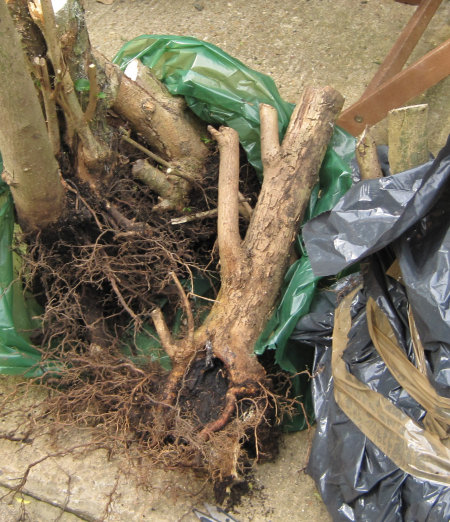
May 2012: A smaller trunk on the day of collection prior to being potted up.
.JPG)
By January 2013, the tree had not only survived but also extended several strong new shoots. I was already able to see where the live and dead parts of the trunk were, and envisage a design for this tree as a bonsai.
(Pictured above) The Privet was very roughly carved to establish the basic design on the tree, and the future branch structure chosen (by removing any shoots that would not be required in the future).
.jpg)
September 2013: After a further season of growth, the Privet bonsai was repotted into a smaller plastic training pot, the deadwood refined and the branches wired.
Height 15"/37cm, trunk diameter 5"/12cm